The HURCHEON
or Erinaceus europaeus
Caught on camera

I t became pretty obvious that a video camera that would work at night was going to be essential. What follows may assist the absolute novice in such matters but bore the pants off everyone else. The generic term for such cameras seems to be ‘trail cameras’. There are innumerable different makes. I tried 6 and returned 5 for much the same reason; they are at best incredibly unreliable and at worst fail to work at all. Having said that, like all technology the kit is changing all the time and I have not kept pace with developments. My budget initially was £50-60. Much of the advertised technical abilities of these cameras, such as trigger speeds and effective operating distance is all my eye and Betty Martin. If anything is recorded, animals will seemingly materialise out of thin air in the centre of the field of view, but how they got there is not recorded. Very often, and for no apparent reason, nothing is recorded. For example, there was so much activity going on one night that I got up to investigate and took this image. The camera shown in the image was plugged into the mains but recorded nothing whereas I witnessed the two urchins romping up and down the path, and going in and out of the feeder. At other times, with exactly the same set-up, the camera would record more-or-less as expected.
T here are endless makes of these cameras but while they have superficial differences they all work in much the same way, have almost identical manuals, run seemingly on the same software and have very similar or identical operating menus all of which suggests they are basically all either made by the same outfit or are assembled using the same or very similar components. Either way they are all basically not worth bothering with. I might add that each camera included a ‘free gift’ offer only obtainable on giving the product a 5 star rating! so product ratings obviously need to be taken with a bucket of salt. I have since upped the budged to £120-150 without markedly better optical results but slightly more reliable end results. Having said that, I would not recommend what I bought to anyone, so won't name it here.
T he things I took most note of when choosing a camera were how many mega-pixels the camera can record. Balancing clarity of picture with overall cost suggested to me 16MP. Having had both 14MP and 16MP cameras I can say that there is a difference and it is worth going the extra half inch for 16MPs rather than 14MPs. However, there is smoke and then there are mirrors.
M ost megapixel ratings on trail cameras are ‘interpolated’ as the techy jargon has it. A better word would be inflated. Interpolation is the addition of extra pixels generated by software rather than the optics, to increase the resolution of the basic optically achieved image. Theoretically, the more pixels in an image, the greater the detail and the clearer and sharper the image. Most basic trail cameras start with a 4-5MP optical image which is then inflated or ‘interpolated’ digitally to whatever headline resolution is claimed for the camera. Interpolating images can be as crude a process as simply adding extra pixels identical to each optical pixel, splitting the original pixels into 4, 8, or 16 extra identical pixels. Naturally this neither increases the quality of the picture nor allows greater detail to be seen but does create higher resolution images i.e. images containing more megapixels than the original, but without adding any detail and, in the process, increasing the file size thus requiring greater storage capacity and longer times to upload etc.
A t the business end are the number of LCDs that illuminate the scene. The more the merrier as far as I am concerned. Most have around 40 but some have fewer than 30 which at a guess would be less good. There are 3 flavours; no glow, low glow, and red glow. As I am not interested in using the camera for ‘security’, the red glow, which tend to be cheaper but also give clearer images that are better lit and are fine as far as I am concerned. In my experience the trigger speeds and operating distances are largely make-believe.
I t is worth taking note of the case ratings. They are usually quoted in IP [International Protection] numbers. Some are only dust-proof - totally useless for outdoor use in G.B. The first digit indicates the level of protection that the case provides against access to sensitive parts by the ingress of solid foreign objects e.g. dust. Aim for at least 5; better is 6. The second digit indicates the level of protection that the case provides against harmful ingress of water. Again, go 5 or a 6. 7 and over refer to immersion. Refer to Wikipedia for the full details; certainly don't rely on the sales blurb! Most claim video resolution of 1920 x 1080. Less is less. Finally, batteries and memory cards. None of the cameras I tried included either.
BATTERIES All the cameras I looked at needed a full 12v to work correctly - the equivalent of 8 x AA batteries. What the camera's sales blurb usually fails to mention is that trail cameras won't work properly with rechargeable batteries which for some reason are only 1.2v whereas non-rechargeable batteries are 1.5v These cameras all seem to require the full 1.5v and will either not work at all or be even less reliable than they are generally if you use rechargeable batteries - as I tried to! As I only use a trail camera on my own property I generally connect it to mains electricity transformed down to 12v. This does little to improve reliability but does mean I waste less money on batteries. If you are going to rely on batteries, they should be lithium, not alkaline. The former cost more but last longer and their voltage does not drop with each successive use as is the case with alkaline batteries. The latter are also susceptible to voltage drop in cold weather.
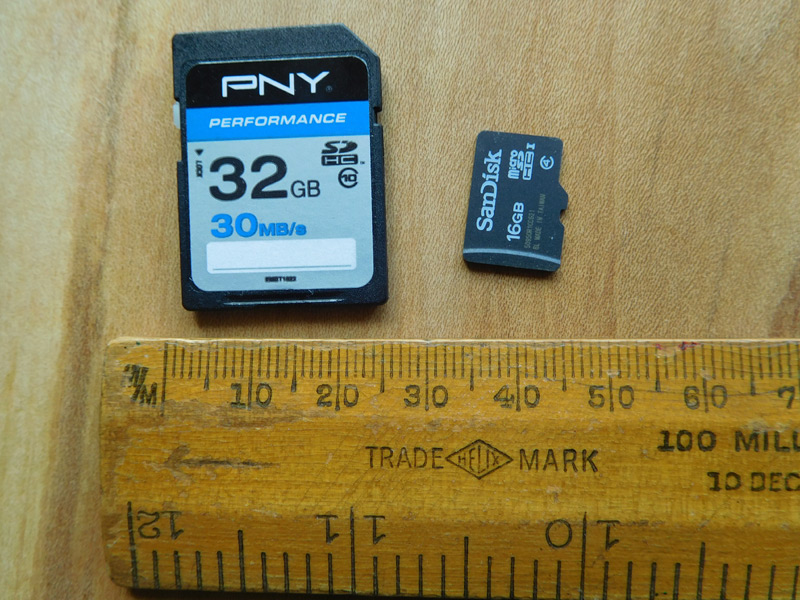
MEMORY Some cameras are wireless and can transmit their data. I was not interested in these but wanted one with a memory card. Most can operate using up to 32GB cards. What they very often do not spell out - and even if they do it is far from obvious and sometimes downright misleading - is what sort of memory card is required. There are principally 3 sorts; SD, miniSD and microSD. Their capacities are similar but their physical sizes are not. All the cameras I have seen use either SD [at left] or microSD [at right]. Although the card on the right is only 16GB they are available in 32GB or over. To give you some idea how much space you might need, 2 minutes at max size, resolution etc is less ¼GB. Put another way, I noted that 14 scenes of 20” each used less than 3 GB of memory. You can get an adaptor to use a micro SD in a camera requiring an SD card but not vice versa.
Duncan Linklater © 2025