QUIVIS Birdseed Survey
What seeds birds eat in my garden.
And, more to the point, which they don't.
I n January 2011 it became clear that I was wasting money on bird food that the birds in my garden in rural Somerset, England, would not eat, so I decided to try and establish what food they would eat.
There were 3 questions I wanted to answer.
- Which, if any, brand of mixed seed did the birds prefer? or
- Would I be better off buying separate seeds?
- If so, which seeds were most acceptable to the birds and my wallet?
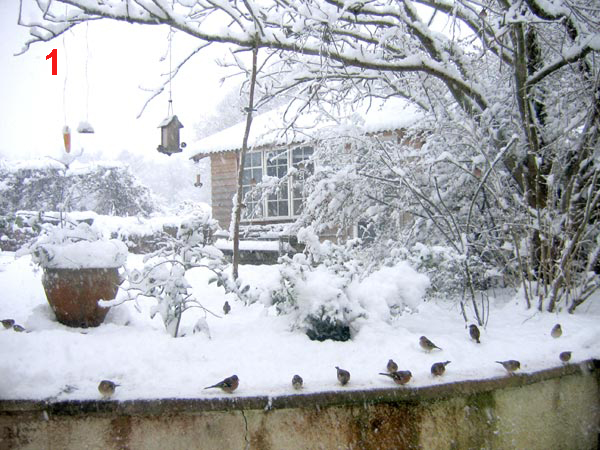
D ecember 2010 had been unusually cold. Birds came to feed in my garden in large numbers. The bulk of the food was placed in feeders, but during the worst of the weather I scattered food along the top of a low wall - see Image 1 above. The disadvantage was that the food was lost under subsequent snow falls. To solve the problem I swept a bit of path clear, placed a glass topped table over it and scattered bird seed under. The food in question was Harrison's All Seasons Wild Bird Food. I was rather surprised to note at the end of the first day that the bulk of the food remained uneaten in spite of the harsh weather see Image 2. There had been plenty of birds hopping around and pecking and scratching at it, so they were clearly not deterred by the table overhead.
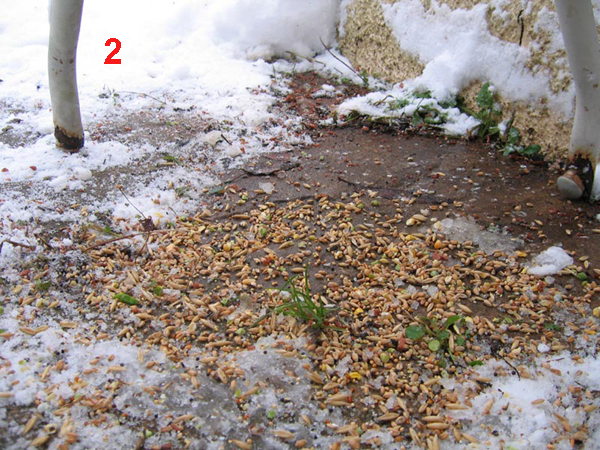
Among the uneaten seeds were wheat, oats, peas, maize, and various small round seeds resembling yellow and red millet and rape. Wheat predominated.
B elow is a list, in no particular order, of birds that were commonly seen on or around the feeders in my garden in January 2011. The operative word is ‘commonly’; a few weeks later I saw a Great Spotted Woodpecker Dendrocopos major on a seed feeder, but I think it was just investigating. It normally confines its efforts to the peanuts.
- Blackbird Turdus merula
- Blue tit Parus caeruleus
- Coal tit Parus ater
- Great tit Parus major
- Chaffinch Fringilla coelebs
- Greenfinch Carduelis chloris
- Goldfinch Carduelis carduelis
- Dunnock Prunella modularis
- House sparrow Passer domesticus
- Robin Erithacus rubecula
- Starling Sturnus vulgaris
- Wood pigeon Columba palumbus
- Collared dove Streptopelia decaocto
- Pheasant Phasianus colchicus
 A
t the time I used mainly two sorts of feed; peanuts and packaged
mixed seeds. As I was only interested in seed consumption, I have
listed above only those birds that showed an interest in seed as
opposed to those which only showed an interest in peanuts or other
food. For example, although bullfinches
Pyrrhula pyrrhula
regularly visit my garden I have never seen them on the seed
feeders, in spite of bullfinches featuring prominently - and
misleadingly in my view - on the packaging of Harrison's All Seasons
Wild Bird Food. On 27 Jan 2011, on two separate occasions, I spent 5
minutes watching a female bullfinch gorging on Amaryllis shoots less
than two feet from a seed feeder receiving heavy traffic from other
birds. The bullfinch completely ignored the Harrison seed in the
feeder and the spilled seed on the ground. Image 3 shows a random
sample of 4 oz of Harrison's All Seasons Wild Bird Food.
A
t the time I used mainly two sorts of feed; peanuts and packaged
mixed seeds. As I was only interested in seed consumption, I have
listed above only those birds that showed an interest in seed as
opposed to those which only showed an interest in peanuts or other
food. For example, although bullfinches
Pyrrhula pyrrhula
regularly visit my garden I have never seen them on the seed
feeders, in spite of bullfinches featuring prominently - and
misleadingly in my view - on the packaging of Harrison's All Seasons
Wild Bird Food. On 27 Jan 2011, on two separate occasions, I spent 5
minutes watching a female bullfinch gorging on Amaryllis shoots less
than two feet from a seed feeder receiving heavy traffic from other
birds. The bullfinch completely ignored the Harrison seed in the
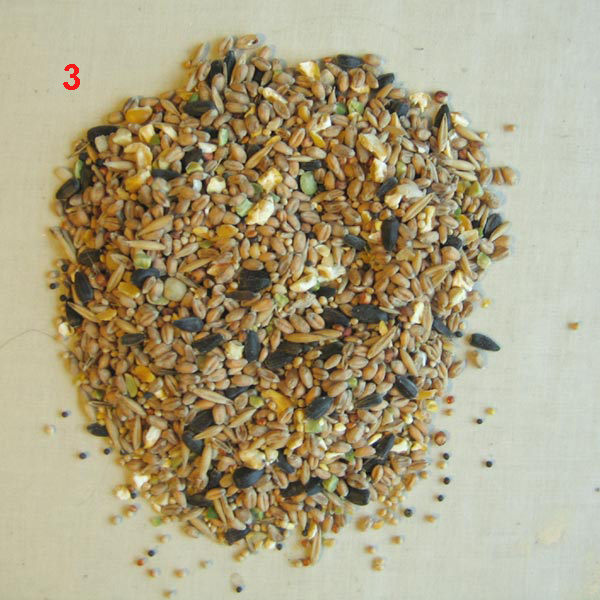
feeder and the spilled seed on the ground. Image 3 shows a random
sample of 4 oz of Harrison's All Seasons Wild Bird Food.
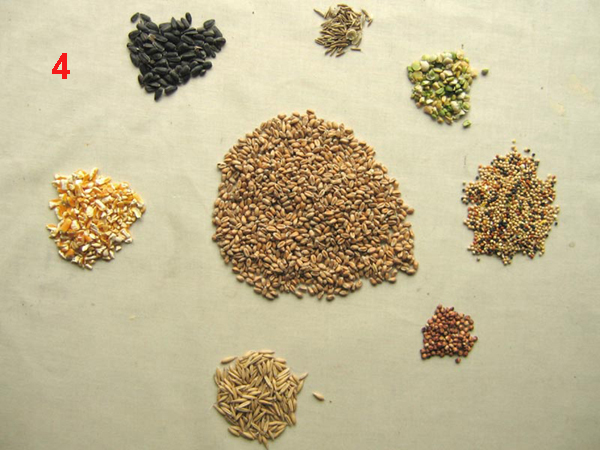
I sorted the above sample into its constituent grains. Image 4 is of the sample shown in Image 3 after sorting - testimony that I need to get out more. Starting from top left of Image 4 and going clockwise I identified the seeds as follows; black sunflower; unidentified ‘grasses’ and dross; split peas; mixed rape and red and yellow millet and possibly other small seeds; red dari; un-milled oats; and cut maize. In the centre is wheat.
 T
he samples in Images 3 and 4 contained approximately the following
weights and percentages of seeds. [In case anyone is counting they
were weighed in identical bags. 8 bags weighed slightly <
½ oz.] < = less
than > = more than
T
he samples in Images 3 and 4 contained approximately the following
weights and percentages of seeds. [In case anyone is counting they
were weighed in identical bags. 8 bags weighed slightly <
½ oz.] < = less
than > = more than
- 2½ oz wheat = 55%
- < ½ oz rape, millet = < 11%
- < ½ oz maize = < 11%
- ¼ oz peas = 5.5%
- ¼ oz black sunflower = 5.5%
- ¼ oz oats = 5.5%
- < ¼ oz red dari = < 5.5%
- < ¼ oz dross = < 5.5%
I n January 2011, 20 kg of Harrison's All Seasons Wild Bird Food cost £11.34 i.e. slightly under 57 pence per kg. My guess at this stage was that at least half the feed was uneaten. So the food the birds actually ate cost about £1 per kg. In January 2011 I was quoted the following prices for unmixed grain bought by the sack-full from one supplier; I was unable to get prices for all the seeds.
- wheat = 31 p per kg
- maize = 38 p per kg
- peas = 44 p per kg
- black sunflower = £1.12 p per kg
- oats = 34 p per kg
I n effect, at the above prices and percentages, each seed in the All Seasons mix is priced up to approximately £2 per kg or 6 to 7 times the price of seeds when bought separately.
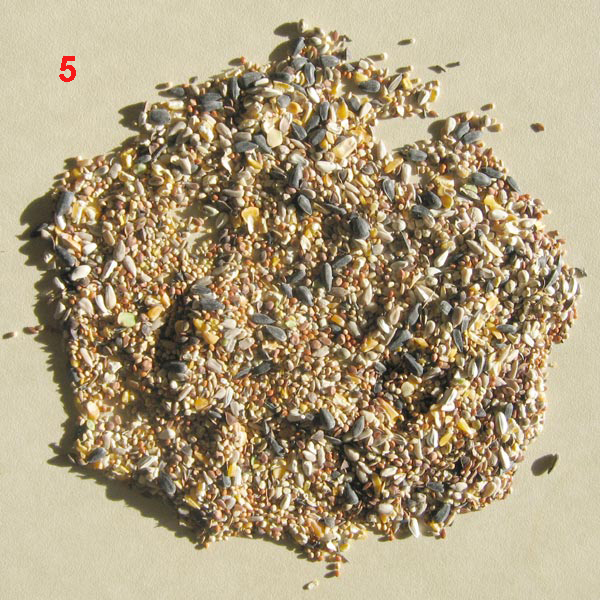
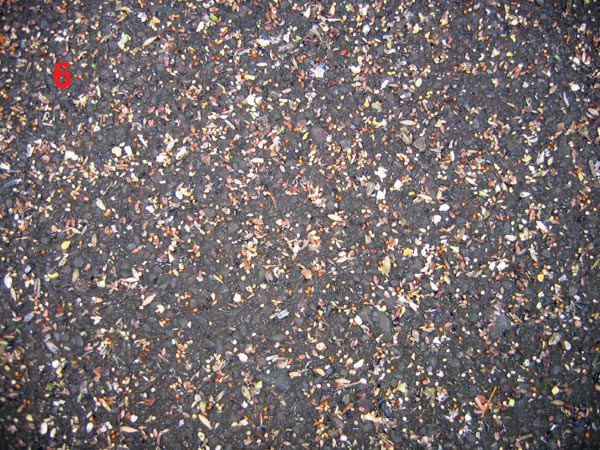
24 January 2011 In an attempt to get a seed mix containing a greater proportion of seeds that the birds might be willing to eat I bought a sack of Harrison's ‘Premier Wild Bird Mix’. [Harrisons are not my bête noire; their's was the only bird seed the local retailer stocked at the time. I doubt any other commercially packaged seed would be any better.] Image 5 shows a random 4 oz sample of ‘Premier’. The main difference between Harrison's ‘All Seasons’ and ‘ Premier’ mixes seemed to be that the latter contained no wheat, tacit acknowledgement that the bulk of what is contained in their ‘All Seasons’ is worthless rubbish. Image 6 shows what was on the ground first thing in the morning before re-filling the feeder with ‘Premier’ for the second time. The stuff on the ground was not only uneaten by birds during the previous day but also uneaten by rodents overnight. I commonly get grey squirrels, rabbits, rats, and mice in the garden. The underlying black stuff is tarmac rather than a mountain of sunflower seeds.
H arrison's Premier Wild Bird Mix claimed to contain the following; Cut Maize; Sunflower Hearts; Red Millet; Yellow Millet; Red Dari; Peanut Granules; Black Sunflower; Pinhead Oatmeal; Canary Seed; Linseed; Buckwheat; Safflorseed; Split Peas; Niger Seed; Hemp.
O f the above ingredients Peanut Granules, Canary Seed, Linseed, Buckwheat, Safflorseed, Niger Seed, and Hemp were not represented in the All Seasons mix. I buy peanuts by the sack, so didn't need to have them included in bird seed. I have never seen a canary in my garden. Buckwheat sounds American, and at the time I had never heard of Safflorseed or Niger Seed. That left Linseed and Hemp. The Premier cost £12.16 for an 8 kg sacks = £1.52 per kilo as against 57p per kilo for the All Seasons i.e. nearly 3 times as much.
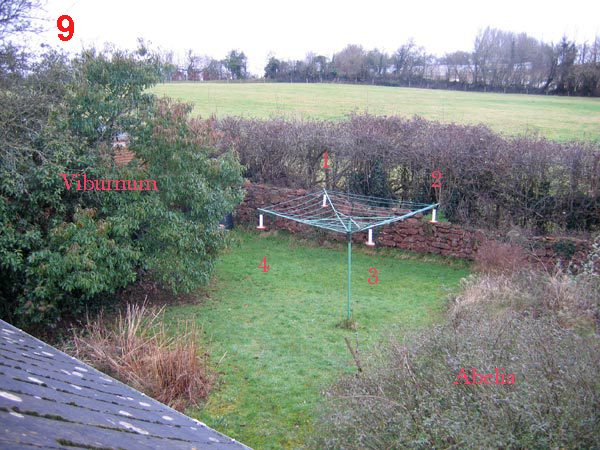
30 January 2011 My first task was to establish which of the various individual seeds the birds in my garden actually preferred. To start with I filled 4 feeders with Harrison's ‘Premier’ wild bird seed to habituate the birds to feeding from new feeders in a different place from normal. Image 9 shows the feeders in situ awaiting customers. There was no laundry done during trials. As shown below, feeder 1 was at NW, 2 at NE, 3 at SE and 4 at SW.
E ver inquisitive Blue Tits were first to inspect. They began their investigations within an hour of the feeders being put in position. By the end of the first afternoon the feeders were also visited by Great Tits and a Robin. A Blackbird took advantage of spillages. I continued to feed mixed seed until the new feeders were as popular as the old ones - i.e. emptied in a day. I then intended filling each with a separate single seed type to see which was preferred.
Q. [For self.] Should the feeders be filled by equal weight? or equal volume?
4 February 2011 Since introducing the new feeders, swarms of Blue Tits, a few Great Tits and the occasional Robin fed from them directly. Timid Chaffinches and a rabble of Sparrows scratted about on the ground under the feeders in company with Black Birds, Pigeons and the odd Dunnock. I noticed Great Tits etc turfing stuff over-board from the new feeders in the manner of Joshua Slocum jettisoned his alarm clock. Image 10, taken after a week, shows what the birds thought of Harrison's ‘Premier’ bird food under a feeder positioned at the front of my property.
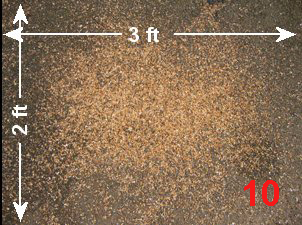
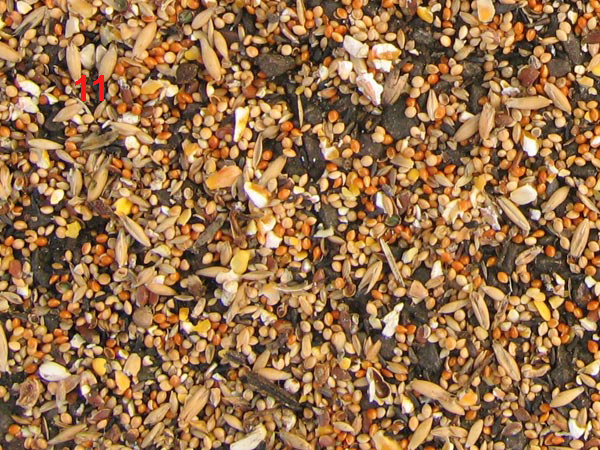
J ust because the birds emptied the feeders did not mean that they were actually eating it. The feeders positioned over grass contained the same feed as the old feeder beneath which was the heap of rejected seed shown in Image 10 and close-up in Image 11. The rejected seed included; yellow and red ‘millet’, rape, red dari, oats, peas and maize. Comparing these two images with the Image 6 shows that the rejects had now almost totally obscured the tarmac. If nothing else, I could expect some interesting stuff to mow later in the year.
5 February 2011 At the end of nearly a week the regulars at the new feeders remained Blue Tits, Great Tits, an occasional female Chaffinch and a Robin. Only one Robin seen at a time, with no opportunist rivals noted lurking which led me to assume it was the same individual. Likewise the female Chaffinch; an increasingly regular visitor on the feeders but I only ever saw one at a time. Her female companions and all the males remain earthbound. There were occasional Coal Tits as well. “STOP PRESS! I can now add Greenfinch to the list. This is particularly gratifying; having been plentiful till a couple of years ago, they have been in short supply of late. There are at least two regular visitors.”
T he birds did not appear to have a marked preference for any one of the 4 feeders but they land least frequently on whatever feeder is at the SE position [Image 9 above]. The birds assembled mostly either in the hedge or the Viburnum. They seem to head for the nearest feeder from wherever they are perched. If the wind did not see to the random distribution of feeders I saw to it myself. It's a hard life.
I decided that as soon as I could lay my hands on a supply of separate seed I would begin the single seed preference trials. I needed 1 kg of each of wheat, oats, crushed maize, crushed peas, millet, sunflower, and red dari. I decided to use crushed peanuts as a control. I knew the birds ate that! All that was holding me up was a supply.
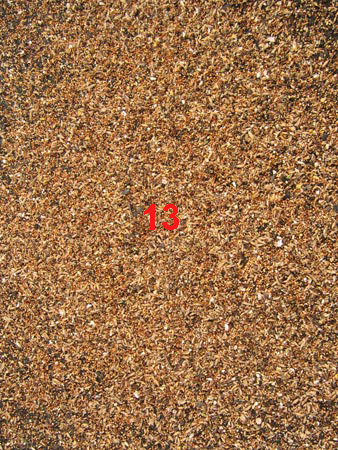
I saw a male House Sparrow on the feeders - whether more than one I was uncertain - but no females. Whereas female Chaffinches continued to be regular feeders on the dish feeders, males would only occasionally approach the dishes but not land, preferring to tread water frantically before either flying off in a funk or snatching at a morsel to retreat and eat. Meanwhile the grain mountain continued to accumulate under the old feeder and now completely obscured the tarmac as shown in Image 13. Not even the rodents ate it!
E ach of the new feeders held about a ¼ of what the other ‘standard’ double-decker feeders could hold - shown at left in image 12 above. The latter were each emptied in about a day but could only accommodate 4 birds at a time, whereas the new feeders could each accommodate at least 2 birds a piece. So if the new feeders were not emptied as quickly or quicker than the old ones, something was amiss.
14 February 2011 “Whan every foul cometh there to chese his make” and the birds in my garden were doing much the same. Frenzied feeding with many displays of rivalry and some birds gathering nesting materials. More than one Robin now visited the feeders. Male chaffinches and female sparrows also ventured onto the dish feeders occasionally but they continued to feed in greater numbers on the ground. Greenfinches were proficient stokers, shovelling grain overboard from the dish and other feeders by the beak full. Mercifully, “it droppeth as the gentle rain from heaven upon the place beneath” where, being “twice blessed it blesseth him that gives and him that takes.” The takers included Sparrows, Chaffinches, Dunnocks, and bigger birds such as Blackbirds pigeons etc.
T his blog [for such it originally was] seemed to become as much about home made bird feeders as about the food they contained, but that all helped pass the time while I awaited the arrival of some promised ‘niger’ seed, or ‘nyjer’ as it is coyly spelled by some semi-literates, before cracking on with the single seed trials. Towards the end of February I finally had enough single seeds to start trials which are reported on The ‘Trials’ Page - or click 2 below.
Duncan Linklater © 2025