Margaret Lilian BOISSARD
6.x.1916 - 21.viii.2003
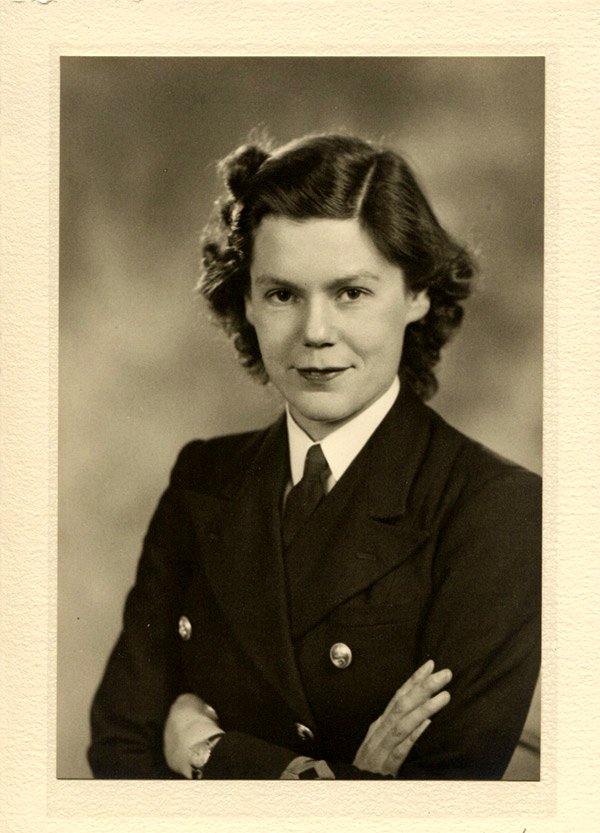
| BORN | 6 October 1916, Escuintla, Guatemala |
|---|---|
| FATHER | Tomé Ariste BOISSARD (1875-1928) |
| MOTHER | Violet Agatha née MELVILLE (1886-1969) |
| MARRIED | 31 July 1944 Nelson Valdemar LINLATER in Falmouth |
| CHILDREN | Robin Valdemar LINKLATER 4 May 1945 Duncan Melville LINKLATER 10 April 1948 |
| DIED | 21 August 2003 in Wellington, Somerset |
 Peggy was the youngest of three children born to Tomé Ariste BOISSARD
and Violet Agatha née Melville - the latter always known as ’Shuffle‘. Peg,
according to her birth certificate, was born at El Salto, Escuintla,
Guatemala. Her father, described as a “planter”, had a finca
in Guatemala called ‘Mauricio’ in Palin on which he grew sugar.
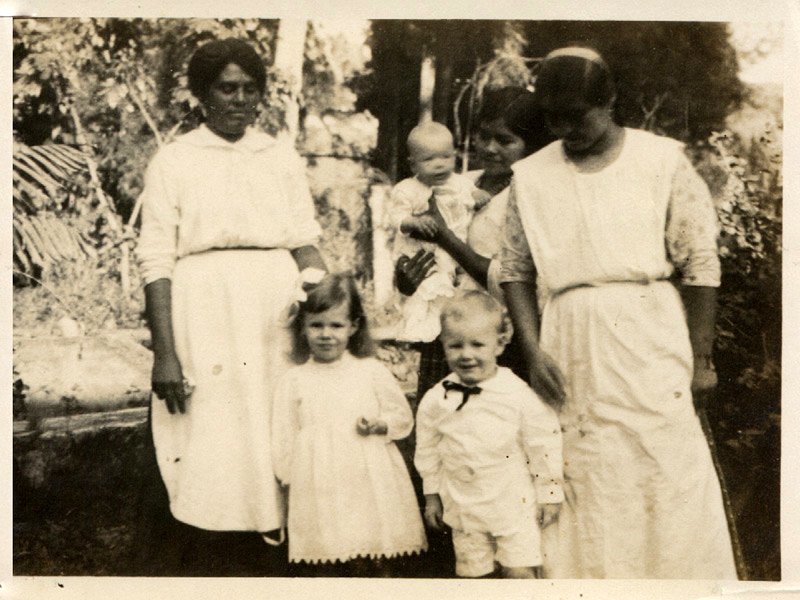
In the image at right, taken around 1917, Peggy is the one being held while Jo and Guy are standing. Standing at left is their nanny, of whom Peggy always spoke very fondly. Her proper name was Roselda, but she was known as ‘Nenen’. Her husband, Evariste,
also had a nick-name; ‘Cucul’. Although it seems he spent
most of his time in the sugar plantation, he was apparently also a fine
cook and on high days and holidays, especially if a fancy, tiered cake
was required, the cry went up for “Evariste!” from the older
generation or “Cucul!” from the younger. Roselda and Evariste
may have been with the family in Mauritius before moving with them to
Guatemala.
Peggy was the youngest of three children born to Tomé Ariste BOISSARD
and Violet Agatha née Melville - the latter always known as ’Shuffle‘. Peg,
according to her birth certificate, was born at El Salto, Escuintla,
Guatemala. Her father, described as a “planter”, had a finca
in Guatemala called ‘Mauricio’ in Palin on which he grew sugar.
In the image at right, taken around 1917, Peggy is the one being held while Jo and Guy are standing. Standing at left is their nanny, of whom Peggy always spoke very fondly. Her proper name was Roselda, but she was known as ‘Nenen’. Her husband, Evariste,
also had a nick-name; ‘Cucul’. Although it seems he spent
most of his time in the sugar plantation, he was apparently also a fine
cook and on high days and holidays, especially if a fancy, tiered cake
was required, the cry went up for “Evariste!” from the older
generation or “Cucul!” from the younger. Roselda and Evariste
may have been with the family in Mauritius before moving with them to
Guatemala.
There was also a cat.
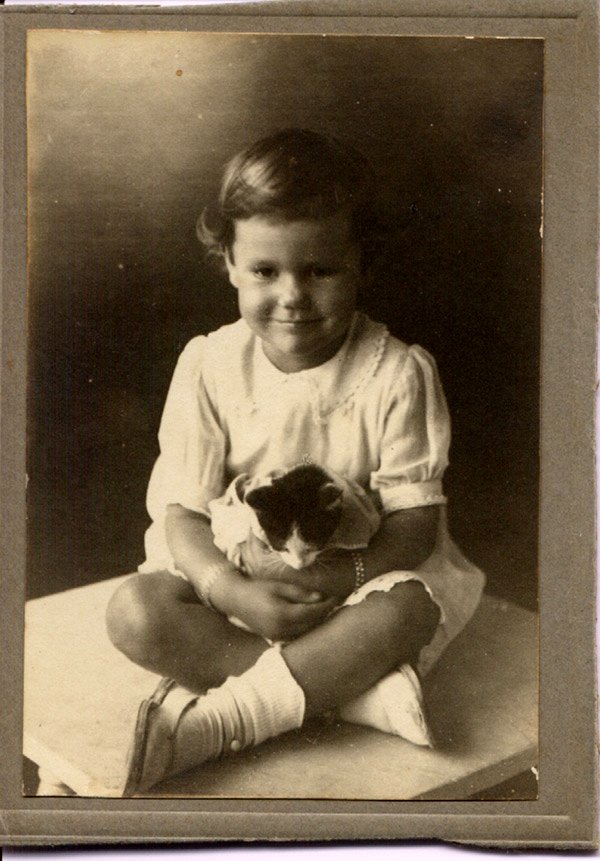 I only came across this photo when Peg was in her 80's. When she saw
it, it evidently evoked memories as clear as yesterday. Straight away she said that the cat was
wrapped in a towel to stop it scratching her
legs. She must have been about 3 or 4 years old at the time the photo
was taken. Peggy's paternal grandmother always stated firmly that she was French
whereas Peggy's grandfather as well as her father insisted they were British
- this in spite of the fact that Peggy always referred to her grandparents
as Grandmère and Grandpère. The Anglophile
tendency prevailed and all the children
were sent to boarding school in England as was common among ex-pats in
Guatemala at the time. In Peggy's case that meant to a prep-school in
Malvern then to Malvern School for Girls. While Peg, Guy and Jo were still
at school their father Tomé died comparatively young in 1928.
The finca was managed in their absence by ‘Uncle Bill’,
Edwin (known as ‘Teddy’) Melville, their mother's (Shuffle's)
brother. It seems that during their remaining time at school and subsequent
training in their various professions, income from the finca
helped meet some of the family's expenses.
I only came across this photo when Peg was in her 80's. When she saw
it, it evidently evoked memories as clear as yesterday. Straight away she said that the cat was
wrapped in a towel to stop it scratching her
legs. She must have been about 3 or 4 years old at the time the photo
was taken. Peggy's paternal grandmother always stated firmly that she was French
whereas Peggy's grandfather as well as her father insisted they were British
- this in spite of the fact that Peggy always referred to her grandparents
as Grandmère and Grandpère. The Anglophile
tendency prevailed and all the children
were sent to boarding school in England as was common among ex-pats in
Guatemala at the time. In Peggy's case that meant to a prep-school in
Malvern then to Malvern School for Girls. While Peg, Guy and Jo were still
at school their father Tomé died comparatively young in 1928.
The finca was managed in their absence by ‘Uncle Bill’,
Edwin (known as ‘Teddy’) Melville, their mother's (Shuffle's)
brother. It seems that during their remaining time at school and subsequent
training in their various professions, income from the finca
helped meet some of the family's expenses.
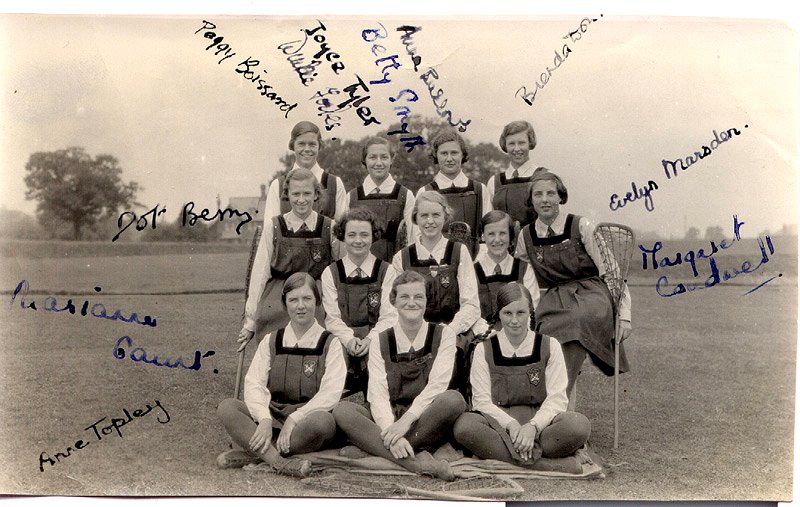 Apart from playing lacrosse, Peggy ‘matriculated’ around
1934 and wanted to go to Oxford and become a teacher but fell foul of
her headmistress, Miss Brook, who swore she would see to it that Peggy
never got a place. What exactly was at the bottom of this alleged animosity
was never made clear. Brother Guy suggested as an alternative that Peggy
take up nursing, and so it was that Peggy decided that if she could not
have charge of children's minds then she could at least take care of their
bodies and embarked on her basic training at Great Ormonde Street Children's
hospital.
Apart from playing lacrosse, Peggy ‘matriculated’ around
1934 and wanted to go to Oxford and become a teacher but fell foul of
her headmistress, Miss Brook, who swore she would see to it that Peggy
never got a place. What exactly was at the bottom of this alleged animosity
was never made clear. Brother Guy suggested as an alternative that Peggy
take up nursing, and so it was that Peggy decided that if she could not
have charge of children's minds then she could at least take care of their
bodies and embarked on her basic training at Great Ormonde Street Children's
hospital.
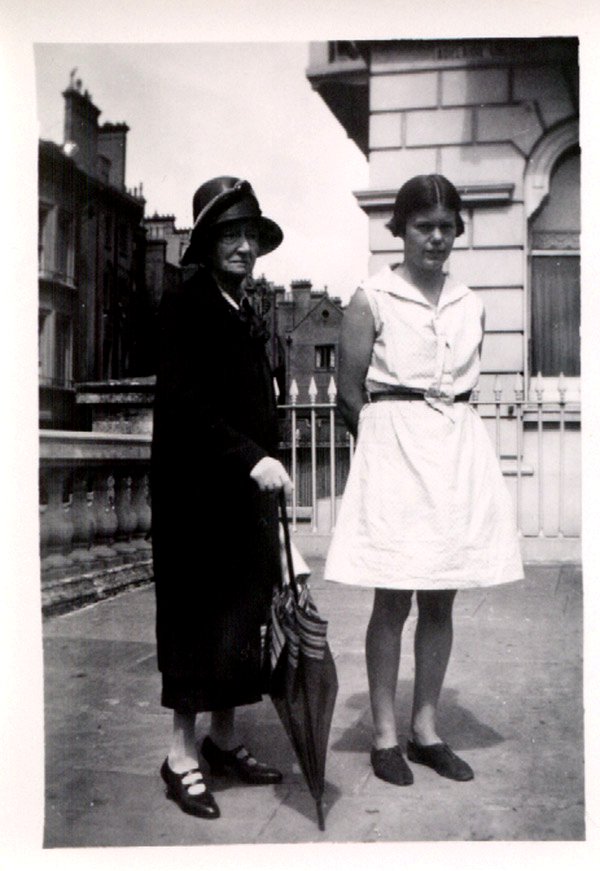 She must have qualified around 1936 and started work. However, things
did not go entirely smoothly. Feathers were ruffled, hackles were raised,
a great stabbing of backs arose; “scandalous allegations”
were made concerning Peggy, which were promptly relayed by her to her
mother. Apparently, though not easily aroused, when goaded into action,
Shuffle was a force to be reckoned with. Traipsing half way round the
globe with three children in tow cannot have been a push-over. Now on
a war footing, along with the rest of Europe, Shuffle sailed into action
and apparently had a massive row with the authorities at Great Ormonde
Street - which helped to the extent that Peggy became a secretary!
She must have qualified around 1936 and started work. However, things
did not go entirely smoothly. Feathers were ruffled, hackles were raised,
a great stabbing of backs arose; “scandalous allegations”
were made concerning Peggy, which were promptly relayed by her to her
mother. Apparently, though not easily aroused, when goaded into action,
Shuffle was a force to be reckoned with. Traipsing half way round the
globe with three children in tow cannot have been a push-over. Now on
a war footing, along with the rest of Europe, Shuffle sailed into action
and apparently had a massive row with the authorities at Great Ormonde
Street - which helped to the extent that Peggy became a secretary!
I think Peggy jumped rather than was pushed into secretarial training (see later) but in any event her training as a short-hand typist was to stand her in good stead. A year or so before the outbreak of the Second World War Shuffle decided to revisit Guatemala and took Peggy with her. The trip was, it seems, principally intended to tidy up any loose ends and to hand over the finca on a permanent basis to ‘Teddy’ Melville. Whether any money passed hands I do not know. It would seem very unlikely that some did not, but whether it did or did not the finca certainly remained partly theirs until the early 1950s when Pat Murray of Murray Beith and Murray, Edinburgh saw to the final transfer of ownership. It was Peg's share of the proceeds that partly enabled her and Dick to buy their first house. But that is getting ahead. Peg and Shuffle returned to England shortly before the war and, although Peggy was apparently offered private nursing work by or through Great Ormonde Street, the allure of the qwerty keyboard seemed irresistible. Plus it was time to sort out Herr Hitler.
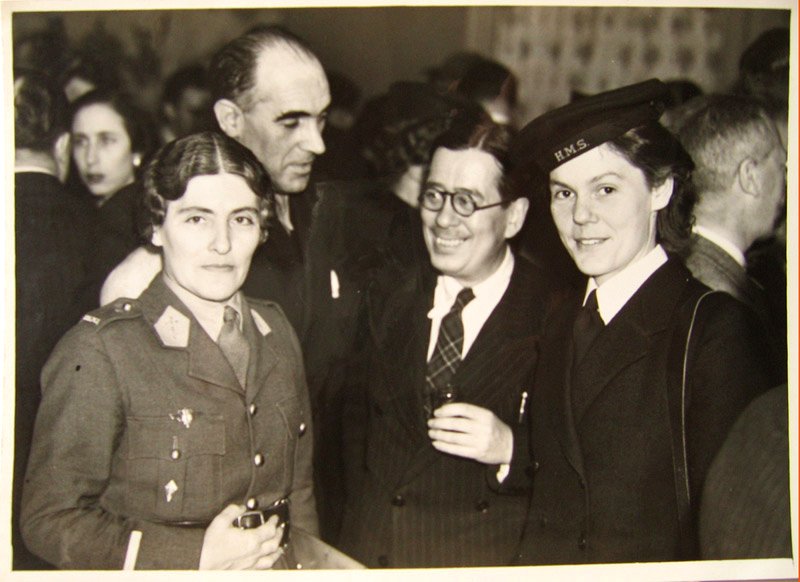 To that end she joined the WRNS and trained as a cypher clerk at Chatham.
She was then promoted to ‘codes’ which eventually led to her
being posted to Falmouth and work in censorship. This image was published in a newspaper
with caption: Conchita Moulun y Margarita Boissard, las dos voluntarias
guatemaltecas que sirven en las Fuerzas Aliadas conversan con los perioditsas Antonio Soto y
Eugenio de Larrabeiti. The two men, Antonio Soto and Eugenio de Larrabeiti, were apparently
important figures in Spanish language wartime media. Antonio Soto also worked for the BBC Latin
American Service as well writing scripts and conducting interviews to broadcast news of Allied
efforts back to the Americas. Eugenio de Larrabeiti was also a prominent journalist and foreign
correspondent. Above the photo Peg wrote in her album “Conchita Fighting French”. It was
while serving at Falmouth that Peg met and
eventually married ‘Dick’ Linklater who was also stationed
there at the time. The manner of their courtship may owe something to
Dick's theatrical training and knowledge of ‘A Midsummer Night's
Dream.’ Rather than through a hole in a wall however, they exchanged
messages through a hole in the floor - or ceiling, depending on your view
point. They resorted to this bizarre method to avoid gossip and were so
successful that the Admiral, who prided himself on knowing everything
that was going on, was apparently ignorant that any ‘negotiations’
were afoot until presented with a fait accomplis by their engagement.
Being a good loser he none-the-less agreed to ‘give Peg away’
in the absence of her father, who by that time was pushing up whatever Guatemala has in the way of daisies.
To that end she joined the WRNS and trained as a cypher clerk at Chatham.
She was then promoted to ‘codes’ which eventually led to her
being posted to Falmouth and work in censorship. This image was published in a newspaper
with caption: Conchita Moulun y Margarita Boissard, las dos voluntarias
guatemaltecas que sirven en las Fuerzas Aliadas conversan con los perioditsas Antonio Soto y
Eugenio de Larrabeiti. The two men, Antonio Soto and Eugenio de Larrabeiti, were apparently
important figures in Spanish language wartime media. Antonio Soto also worked for the BBC Latin
American Service as well writing scripts and conducting interviews to broadcast news of Allied
efforts back to the Americas. Eugenio de Larrabeiti was also a prominent journalist and foreign
correspondent. Above the photo Peg wrote in her album “Conchita Fighting French”. It was
while serving at Falmouth that Peg met and
eventually married ‘Dick’ Linklater who was also stationed
there at the time. The manner of their courtship may owe something to
Dick's theatrical training and knowledge of ‘A Midsummer Night's
Dream.’ Rather than through a hole in a wall however, they exchanged
messages through a hole in the floor - or ceiling, depending on your view
point. They resorted to this bizarre method to avoid gossip and were so
successful that the Admiral, who prided himself on knowing everything
that was going on, was apparently ignorant that any ‘negotiations’
were afoot until presented with a fait accomplis by their engagement.
Being a good loser he none-the-less agreed to ‘give Peg away’
in the absence of her father, who by that time was pushing up whatever Guatemala has in the way of daisies.
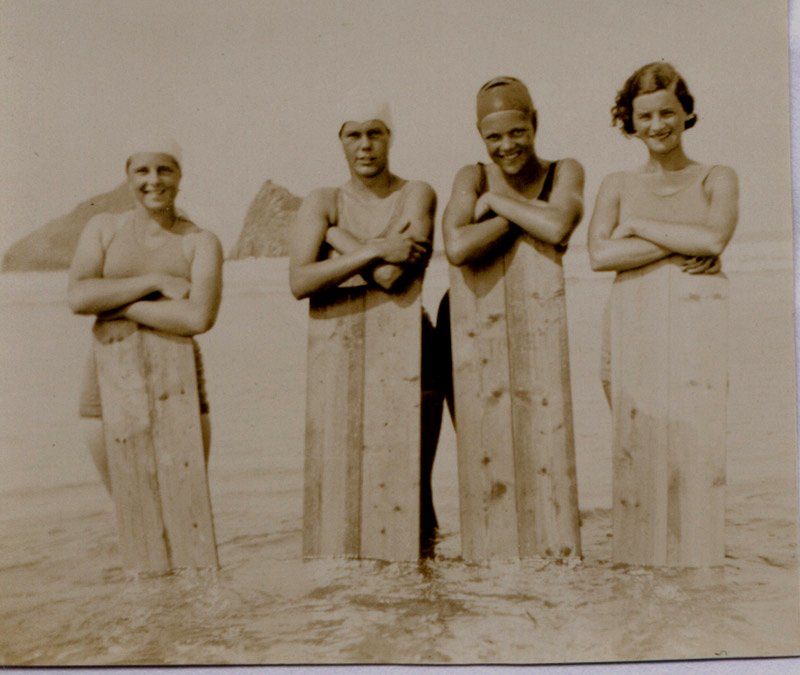 War or no war there not all her time was spent in uniform.
Here for example is Bay Watch nineteen thirties style. Peggy is second
from the left with the pale bathing-cap. Sadly this and other photos from
the same period are very faded. Peggy gets a mention in a mysterious book from which Dick
copied and preserved a number of references concerning his own wartime service.
Peggy crops up as follows; I was living in rooms a
short distance from the office and Dick joined me thus furthering our
friendship. His work load was considerable as he was responsible for issuing
Confidential Books to both R.N. and U.S.N. Ships and Establishments throughout
the Command. Also serving on the Admiral's Staff was Second Officer Peggy
Boissard WRNS of a talented family, who hailed from Guatemala where her
Father had a plantation. They fell in love and were married on 31st July
1944. I was thus left on my own and moved to Church Farm, near Budock
Water 2 miles approx. distant from Falmouth. Living was good with plenty
of eggs, Cornish Cream etc. and kind hosts. I bicycled up and down steep
hills, partly on church paths, but when the Admiral and I were working
late, he insisted that I be taken back by service transport, a procedure
which worried the Maintenance Captain to no avail.
War or no war there not all her time was spent in uniform.
Here for example is Bay Watch nineteen thirties style. Peggy is second
from the left with the pale bathing-cap. Sadly this and other photos from
the same period are very faded. Peggy gets a mention in a mysterious book from which Dick
copied and preserved a number of references concerning his own wartime service.
Peggy crops up as follows; I was living in rooms a
short distance from the office and Dick joined me thus furthering our
friendship. His work load was considerable as he was responsible for issuing
Confidential Books to both R.N. and U.S.N. Ships and Establishments throughout
the Command. Also serving on the Admiral's Staff was Second Officer Peggy
Boissard WRNS of a talented family, who hailed from Guatemala where her
Father had a plantation. They fell in love and were married on 31st July
1944. I was thus left on my own and moved to Church Farm, near Budock
Water 2 miles approx. distant from Falmouth. Living was good with plenty
of eggs, Cornish Cream etc. and kind hosts. I bicycled up and down steep
hills, partly on church paths, but when the Admiral and I were working
late, he insisted that I be taken back by service transport, a procedure
which worried the Maintenance Captain to no avail.
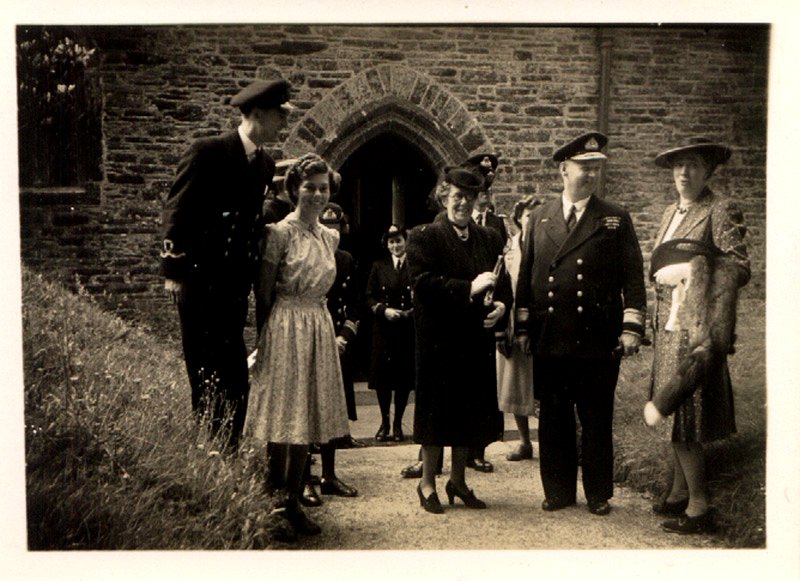 Peggy ceased to be Second Officer Peggy
Boissard WRNS on 31 July 1944 when presumably she became Second Officer Peggy
Linklater WRNS, an event mentioned by, among others, a local newspaper which stated that on that day “at the Church of
St Stephen and St Mawnon, Cornwall, Sub-Lt N.V. Linklater R.N.V.R... [married]
...Margaret Lilian Boissard...” Their union was blessed in due course by the birth of my elder brother Robin, on the 4th of May
1945 in Barry, Glamorgan and then myself, Duncan in case you have not had
the pleasure, born in York in 1948. I am not sure why Robin was born in
Glamorgan except that the war being nearly over, and the happy couple being basically homeless, Peggy I think went to
Glamorgan because her sister Jo was by that time working there as a pathologist and recommended
her ‘quack’ to Peggy. Post parturition Peggy moved from Glamorgan to Norfolk
for a month or two with the infant Robin while Dick, a.k.a. Sub-Lt N.V. Linklater R.N.V.R. (Retd.) or demobbed,
looked for a job which ultimately led to their settling in York for a year or two at ‘Tranby Croft’, The Avenue, Clifton, York where
I think they were lodgers.
Peggy ceased to be Second Officer Peggy
Boissard WRNS on 31 July 1944 when presumably she became Second Officer Peggy
Linklater WRNS, an event mentioned by, among others, a local newspaper which stated that on that day “at the Church of
St Stephen and St Mawnon, Cornwall, Sub-Lt N.V. Linklater R.N.V.R... [married]
...Margaret Lilian Boissard...” Their union was blessed in due course by the birth of my elder brother Robin, on the 4th of May
1945 in Barry, Glamorgan and then myself, Duncan in case you have not had
the pleasure, born in York in 1948. I am not sure why Robin was born in
Glamorgan except that the war being nearly over, and the happy couple being basically homeless, Peggy I think went to
Glamorgan because her sister Jo was by that time working there as a pathologist and recommended
her ‘quack’ to Peggy. Post parturition Peggy moved from Glamorgan to Norfolk
for a month or two with the infant Robin while Dick, a.k.a. Sub-Lt N.V. Linklater R.N.V.R. (Retd.) or demobbed,
looked for a job which ultimately led to their settling in York for a year or two at ‘Tranby Croft’, The Avenue, Clifton, York where
I think they were lodgers.
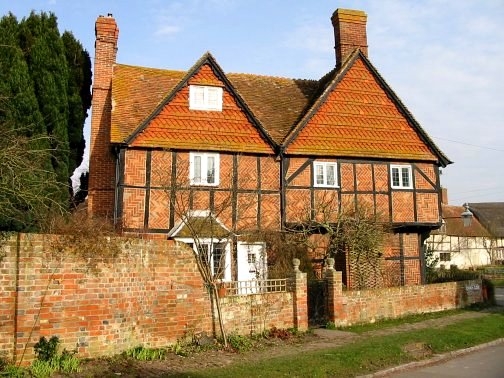
After my introduction to the world in York they bought a house in Nottingham at 636, Wollaton Road some time in 1949 when Dick began work for the Regional Arts Council. I think they were able to buy this property partly with Peg's share of the proceeds from final disposal of Finca Mauricio in Guatemala. When Dick's job moved him to London we moved first to a house called ‘Long Waters’ in Dorney, on the Thames, where we lived for about 6 years. During that time Dick's parents moved from Wallasey, near Liverpool and joined us in Longwaters. Peggy's father in law, ‘Dum’, was by then quite an old man, going blind and in poor health. He died in 1955 while we were still in Dorney.
Following Dum's death we moved to 102 King's Road, Windsor in about 1955 we lived for the next 18 years. The house had a clear view across the Long Walk towards the Mausoleum at Frogmore and was two doors up from the pub, The Prince Albert, which clearly did not have the same connotations as it does nowadays or the pub sign might have been more remarkable than it was. With both her sons now in private schools, (and working really hard!) Peg took to the keyboard again, starting with secretarial work mainly at schools before settling for a while at the Berkshire Education Office. Eventually, giving Miss Brook her comeuppance, Peg decided if you can't beat them you might as well join them so poacher turned game-keeper and Peg trained as a teacher at East Hampstead College when she was in her late forties. For most of the remainder of her working life Peggy was a state primary teacher mainly in schools in or near Windsor.
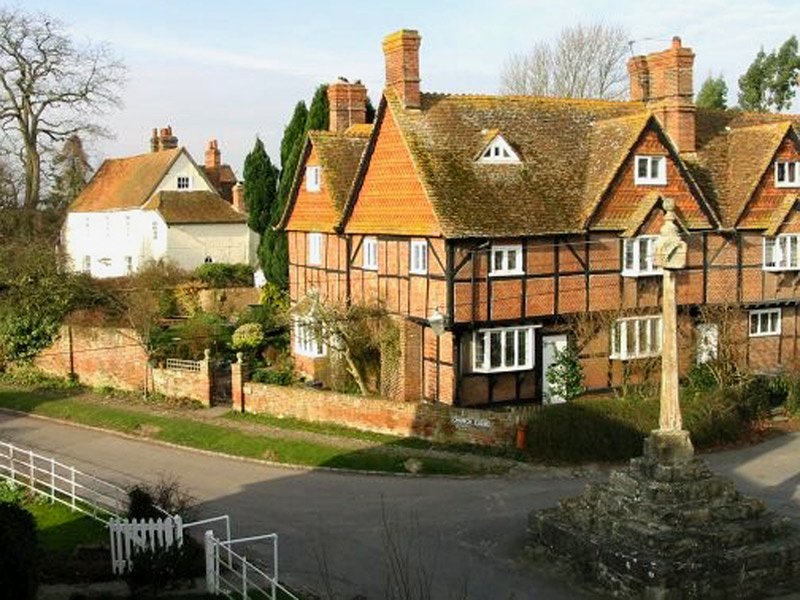 Prior to Dick's retiring they made one more move to get away from the
increasingly tedious numbers of low-flying aircraft on the flight path
to Heathrow laden with tourists who, having no sooner landed, seemed to head
straight for the pavements of Windsor. Looking for a smaller house with
a bigger garden they bought a bigger house with a smaller garden and the uninspiring name of
1 Church Close giving no hint of its Grade II listed building status in the
picturesque village of East Hagbourne. The church, St Andrew's, is less than 100 yards away and it was there, one week
after Peg and Dick settled in East Hagbourne that Sally and I got married in 1974.
Prior to Dick's retiring they made one more move to get away from the
increasingly tedious numbers of low-flying aircraft on the flight path
to Heathrow laden with tourists who, having no sooner landed, seemed to head
straight for the pavements of Windsor. Looking for a smaller house with
a bigger garden they bought a bigger house with a smaller garden and the uninspiring name of
1 Church Close giving no hint of its Grade II listed building status in the
picturesque village of East Hagbourne. The church, St Andrew's, is less than 100 yards away and it was there, one week
after Peg and Dick settled in East Hagbourne that Sally and I got married in 1974.
 In spite of the house only having a small garden, it gave Peg ample scope
to indulge in one of her two main obsessions. In fact it might be said
that Peggy became a manic gardener, her energy and enthusiasm for turning
the sod knowing no bounds. Her other obsession, especially after Dick's
death, was with her little dog Shandy. She was always fond of animals
of all sorts - although strangely leery about cows which she would avoid
if at all possible, using the dog as her main excuse. But her care of
Shandy bordered on the obsessional as indeed was Dick's. Here Peggy can be seen indulging in both her favourite
things - well ok, there's not much gardening actually going on but plenty
of evidence that it has been.
In spite of the house only having a small garden, it gave Peg ample scope
to indulge in one of her two main obsessions. In fact it might be said
that Peggy became a manic gardener, her energy and enthusiasm for turning
the sod knowing no bounds. Her other obsession, especially after Dick's
death, was with her little dog Shandy. She was always fond of animals
of all sorts - although strangely leery about cows which she would avoid
if at all possible, using the dog as her main excuse. But her care of
Shandy bordered on the obsessional as indeed was Dick's. Here Peggy can be seen indulging in both her favourite
things - well ok, there's not much gardening actually going on but plenty
of evidence that it has been.
 In fact we had dogs for as long as I can remember. In the first
instance they were always poodles, a much maligned breed done no favours
by stupid owners giving them ridiculous hairdos. We had poodles because
Dick's sister, Doris, was a breeder who specialised in toy poodles. We
always had ‘normal’ sized ones, whatever they are called,
not the large ‘standard’ variety. Care of these dogs fell
largely on Peg who was a willing victim to the extent that I cannot think
of our poodles without the image of Peg clipping and grooming them coming
to mind. The picture says it all!
In fact we had dogs for as long as I can remember. In the first
instance they were always poodles, a much maligned breed done no favours
by stupid owners giving them ridiculous hairdos. We had poodles because
Dick's sister, Doris, was a breeder who specialised in toy poodles. We
always had ‘normal’ sized ones, whatever they are called,
not the large ‘standard’ variety. Care of these dogs fell
largely on Peg who was a willing victim to the extent that I cannot think
of our poodles without the image of Peg clipping and grooming them coming
to mind. The picture says it all!
After Dick's death Peg came to live with us for a while until the inevitable move into a care home. I asked her once what she called her own father, whom she cannot have known well as he died when Peg was about ten and away at school in England. She astonished me by saying “Dick.” I said something like “no, no, that was my father; but what did you call your father?” She insisted on Dick which I put down to general confusion. But then we had a visit from a very old family friend, Sandra Smith, daughter of Owen Smith and niece of John Smith who had recently written and had published a history of his family who had a coffee plantation in Guatemala and were lifelong friends of the Boissards. This is what John Smith wrote about Tomé.
“Aristide (Dick) Boissard died of cancer in December 1928. Originally from the Island of Mauritius, he had gained experience in the growing of sugar cane and had been contracted by Chalmers, Guthrie and Co. to work at the sugar mill Ingenio El Salto in Escuintla. Like Gordon [Smith, John’s brother] he had also acquired a finca, a small cane finca near Escuintla, which he christened ‘Mauricio’. He left his widow Violet Melville with three young children to educate and only a small income. She finally moved to England where she taught at Malvern Girl’s School, got her children well educated (with financial help from Gordon for Guy’s education) and lived a long life near Cambridge.” [John Gordon Smith: ‘Finca Moca’ (2003) p. 46]
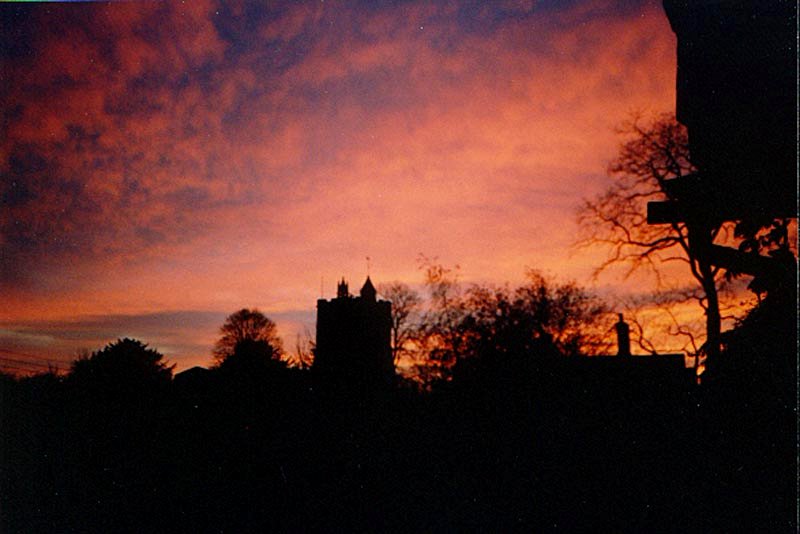
Peg's ashes were scattered in the same place as Dick's in the churchyard of St Andrew's, East Hagbourne and both are remembered in an inscription on some stone steps that my brother and I installed in the south-eastern corner of the churchyard by way of sneaking in an unofficial monument into a churchyard no longer being used for burials. The latter now take place some distance away on a rather dispiriting corporation plot.
IMAGE of steps required
Duncan Linklater © 2025