Arthur David LINKLATER
Work for the Calcutta Port Authority
on the River Hooghly and as a Hooghly Pilot.
There lies the port
 T
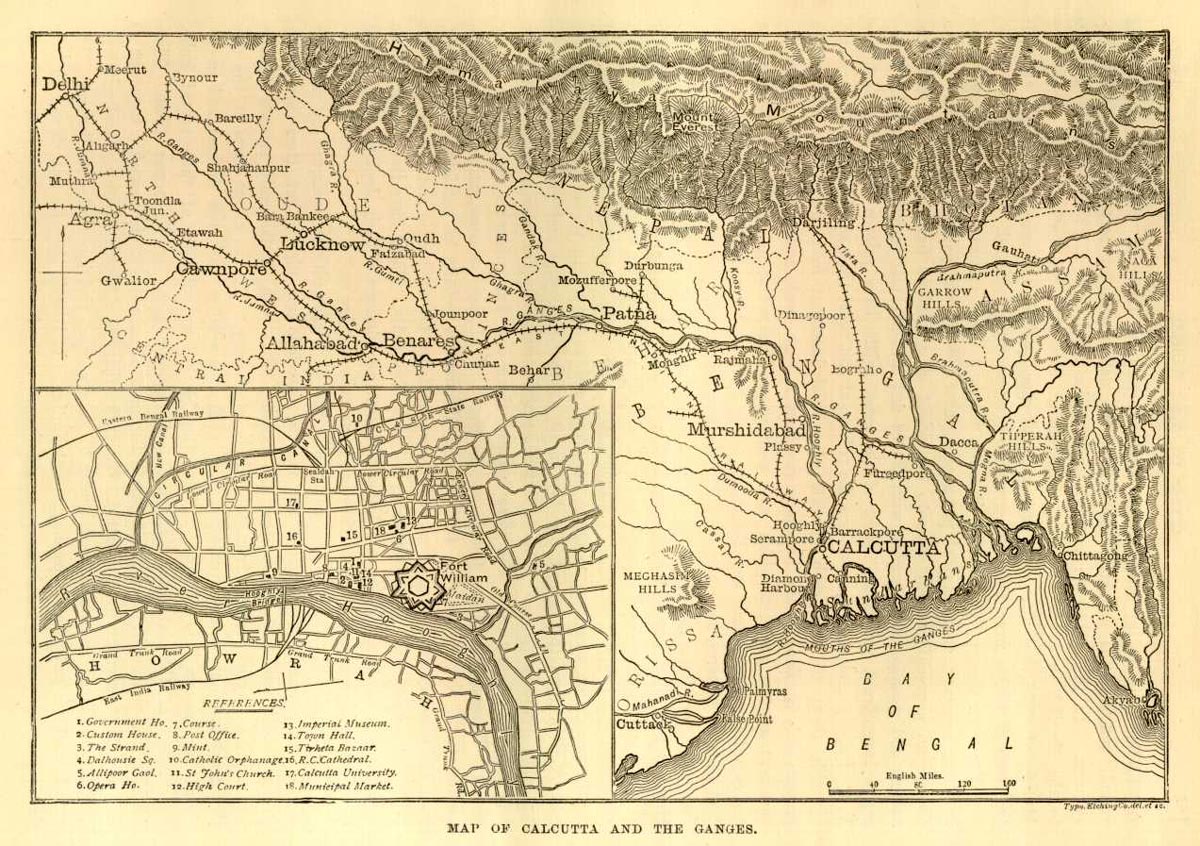
he Hooghly is a notoriously treacherous river, being the
distributary of the Ganges which flows through Calcutta to the Bay
of Bengal. It splits off to flow south from the Ganges slightly to
the north of Murshidabad on the map to the right. It is a very large
body of water, with swift currents, contrary tides, a winding course
and many sand banks which combine to pose exceptionally hazardous
conditions especially during the monsoon seasons. Inevitably, it has
claimed many lives and wrecked many ships. It was only navigable by
large, i.e. ocean going, ships from the Bay of Bengal for about 120
miles northwards as far as Calcutta. What follows here is material
relating directly to Arthur's work on the river.
T
he Hooghly is a notoriously treacherous river, being the
distributary of the Ganges which flows through Calcutta to the Bay
of Bengal. It splits off to flow south from the Ganges slightly to
the north of Murshidabad on the map to the right. It is a very large
body of water, with swift currents, contrary tides, a winding course
and many sand banks which combine to pose exceptionally hazardous
conditions especially during the monsoon seasons. Inevitably, it has
claimed many lives and wrecked many ships. It was only navigable by
large, i.e. ocean going, ships from the Bay of Bengal for about 120
miles northwards as far as Calcutta. What follows here is material
relating directly to Arthur's work on the river.
 O
ne of the first things he had to undertake was securing a pilot's
certificate for the Hooghly in furtherance of which he was given a
character reference stating, among other things that;
... he has been employed as Chief Officer D.V.
Retriever
. He requires this certificate to present himself for a pilotage
certificate - and his general conduct has been in every way
satisfactory. He is of strictly sober habits.
O
ne of the first things he had to undertake was securing a pilot's
certificate for the Hooghly in furtherance of which he was given a
character reference stating, among other things that;
... he has been employed as Chief Officer D.V.
Retriever
. He requires this certificate to present himself for a pilotage
certificate - and his general conduct has been in every way
satisfactory. He is of strictly sober habits.
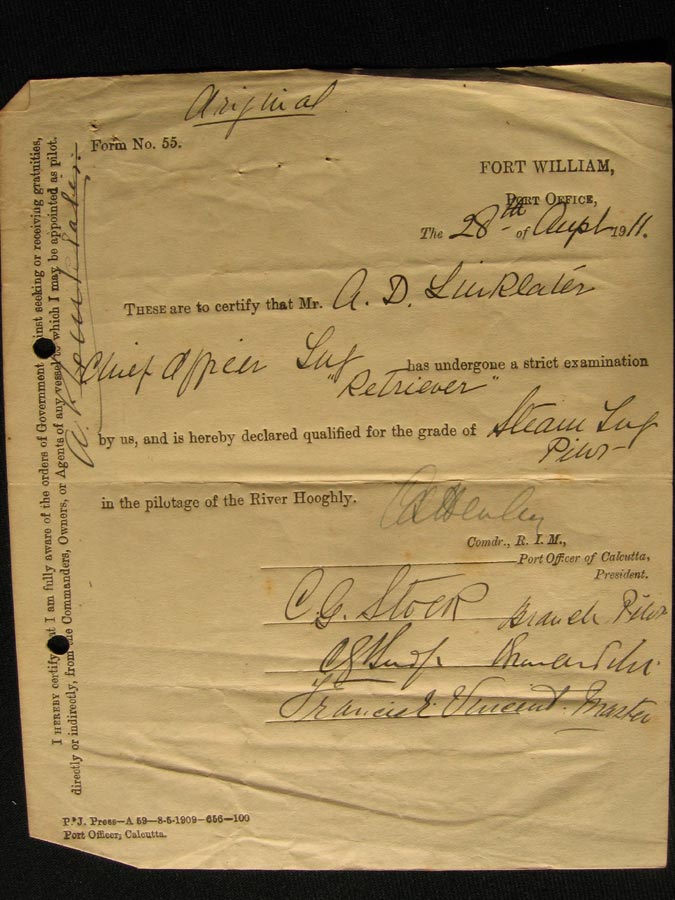
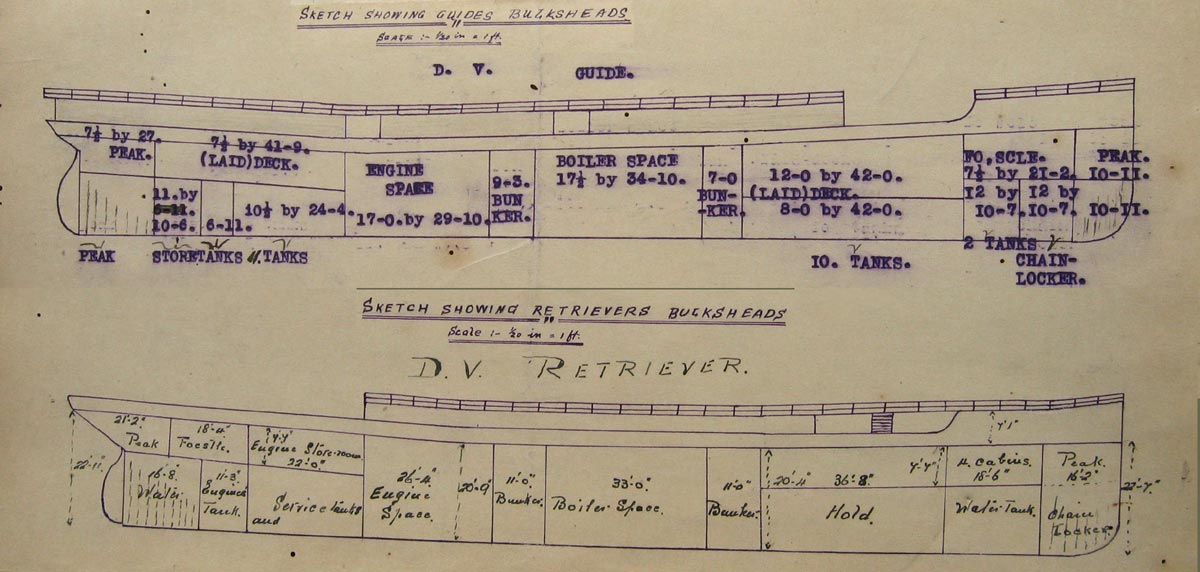
T he Commander of D.V. RETRIEVER [D.V. stands for Dispatch Vessel] at the time was J. M. Parker who gave a similarly glowing character reference presumably for the same purpose. The Pilot's Certificate, which Arthur was duly granted on 28th April 1911, must qualify as one of the most unprepossessing chits ever issued. The certificate, addressed from Fort William Port Office, states; These are to certify that Mr A. D. Linklater Chief Officer Tug "Retriever" has undergone a strict examination by us, and is hereby declared qualified for the grade of ‘Steam Tug Pilot’ in the pilotage of the River Hooghly. Under the words I hereby certify that I am fully aware of the orders of Government against seeking or receiving gratuities, directly or indirectly, from the Commanders, Owners, or Agents of any vessel to which I may be appointed pilot. appears, with his customary flourish, the signature of A. D. Linklater. I am unsure exactly when he first took command of a vessel; but a letter to Arthur from the Commissioners for the Port of Calcutta dated 6th April 1914 is addressed simply to "The Commander, D.V. Retriever ". The breakthrough appears the next day, when on 7th April 1914 he gets the full accolade and is addressed as "Captain A. D. Linklater, Commander, D.V. Retriever ." On the other hand, according to his ‘MIGRATIONS’ in the ‘Folio Commonplace Book’; Took command of Retriever 10 October 1913. Arthur spent most time commanding D.V. Retriever after D.V. Guide [see next page] was requsitioned for War service in 1914. Below is the nearest [i.e.only!] thing to an image of D.V. Retriever that I have.
B efore ascending to captaincy, it was not all plane sailing. Here is a letter Arthur wrote to his boss, the Deputy Conservator of the Port Commissioners, Calcutta dated 4th September 1911.
Sir,
I respectfully beg to point out the injustice done me, by this last
anonymous letter
[so not the first]
in which two members of the ship's company accuse me of having ill
treated them. An inquiry was held in which both deny having had a
hand in the concoction of the letter. To them the matter is of no
further moment. Their purpose has been achieved. They have reported
the chief officer and they see their report has been effective by
the enquiry which is held. This report, although not credited, never
the less is exceedingly detrimental to me. The memory of the report,
however untrue it may have been, must remain with you and I trust
the crew will be given to understand that you do not view with
favour these exaggerated and inflammatory letters. There is not a
man in the ship's company in any way whatever ill treated. What the
trouble is, is that in port, I am never very far away from the men,
and I see that the men do a days work. There is no severe treatment,
and no abuse of power, but there is no loafing, and this I take it,
is one of the main duties of the chief officer to see to.
I have the honour to be sir,
Your Obedient Servant,
A. D. Linklater
 B
eing armed with his Hooghly Pilot's license did not immunise him
from the Hooghly's caprice. His Waterloo is recounted in the Folio
Commonplace Book in a copy of "Letter No. 287" dated 14 Dec 1914 to
the Deputy Conservator which looks a lot like humble pie to me.
B
eing armed with his Hooghly Pilot's license did not immunise him
from the Hooghly's caprice. His Waterloo is recounted in the Folio
Commonplace Book in a copy of "Letter No. 287" dated 14 Dec 1914 to
the Deputy Conservator which looks a lot like humble pie to me.
Sir,
I beg to report the ship
[
Retriever
]
having grounded on the edge of the sand at Hughli Point, about 1850
feet N. 16° W. of the Waterloo buoy, on Sunday the 13th inst at
11.47 a.m., while proceeding down on the ebb tide
[i.e. tide going out, so depth of water dropping. There is a
‘Hoogly Point’ on the map at right about the same
distance below the middle crease as Calcutta is above it. Whether
this is one and the same as ‘Hughli Point’ in Arthur's
account I am uncertain. If it is, then the sharp bend opposite the
major tributary of the Rupnarayan is a notoriously fickle area to
navigate, with very strong currents and tides.]
.
Eight feet was up
[on the tide semaphore]
at Hughli Point when we passed, and we were drawing 14.2 apr.
[?]
When abreast of Lower
[?] [- ? -]
Point, a steamer was observed a little below the Waterloo buoy,
coming up, and so as to avoid meeting on the Gut I stopped and after
the way was off the ship, came down just with stearage way on the
ship, and a little below No.1.
The upward bound steamer was across the Gut before we passed each
other, and I opened out to full speed, and put the helm over to get
into No. 3 but owing to having very little headway, and to having
the gas barge
[presumably in tow]
and row-boat astern the ship sheered broadly across the tide, and
although everything was in order she was set down so much on coming
round on port helm, that we touched the edge of the sand just below
the fairway track and swung round with head N.W.x W.
She touched very lightly as there was little headway in the ship,
but although she was promptly lightened by running out the after
peak and discharging the gas buoys, and the engines used as
necessary she remained fast till the tide had risen to 7.3 at 5.12
in the evening.
Our position was Fort Beacon 86°.50 Semaphore 134°.10 No. 6
(outer). The vessel was in no way strained, and remained nearly on
an even keel throughout and is in perfect working order. The gas
barge, and row-boat are also all well.
I have the honour to be Sir,
Your obedient servant,
A.D.Linklater. Commdr.
Underneath are some other details in pencil.
As the tide fell the vessel listed 4° to starboard, that was she
listed towards the tide. There was 7.9 up when we stuck fast, but
when 7.3 was up her stern (which was towards the flood)
[incoming tide]
commenced moving, and engines were started right away, and 5 minutes
later she got off. The buoys were kept in the water during this
operation, and hoisted after we anchored. The gas-barge and RB had
been cast off shortly after grounding, and anchored.
Arthur's statement that there was 7.9 up when we stuck fast followed by the assertion that when 7.3 was up i.e. even less water, they were able to get off seems to imply that either the semaphore had been showing the wrong depth or the charted depths were wrong. But it could be that the .6 difference is accounted for by the timely action taken to lessen the draught of the vessel by by running out the after peak and discharging the gas buoys .